The Future of Empirical Research in Finance & Economics in the Age of AI
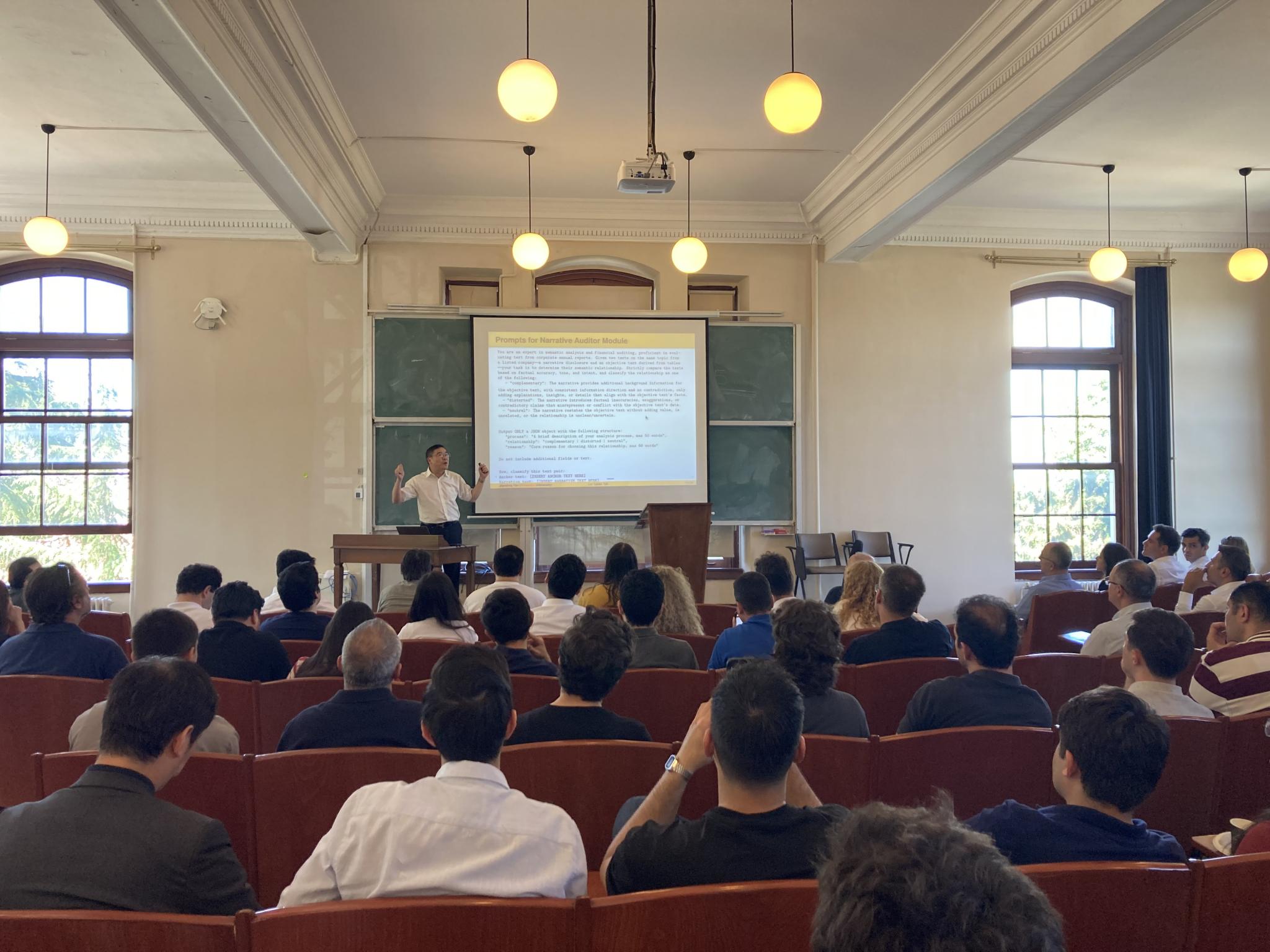
Boğaziçi University Department of Economics Hosts Frontier Seminar on AI in Finance and Economics
Friday, 12 June 2026 | Department of Economics, Boğaziçi University
The Department of Economics at Boğaziçi University hosted a landmark research seminar on Friday, 12 June 2026, bringing together two of the world's leading scholars at the intersection of artificial intelligence, econometrics, and financial markets. Titled "The Future of Empirical Research in Finance & Economics in the Age of AI", the event drew a full audience to TB310 Fen Fakültesi and was organised by Prof. Burak Saltoğlu, Chair of the Department of Economics.
The seminar featured back-to-back presentations by Prof. Jianqing Fan (Princeton University) and Prof. Mehmet Caner (North Carolina State University), followed by discussion and closing remarks.
Opening Remarks: A Call for Rigour in the Age of AI
Prof. Saltoğlu opened the seminar with a clear-eyed assessment of where artificial intelligence stands in economic and financial research. His remarks were not a celebration of novelty, but a call for intellectual discipline. "AI is no longer a future concern," he argued. "It is already reshaping how knowledge is produced, traded, and validated."
Drawing on the Cambridge CCAF 2026 Global AI in Financial Services Report, Prof. Saltoğlu noted a striking paradox: while 81% of financial institutions have adopted AI at some level, only 14% regard it as truly transformational to their strategy. Pilots are everywhere; durable value creation is rare. In quantitative trading, by contrast, AI has already achieved dominance — approximately 70–80% of US equity volume is algorithmic, and around 20% of FX trades are AI-driven. Risk management, however, lags far behind, with 72% of Chief Risk Officers reporting only early-stage AI adoption.
Prof. Saltoğlu also drew attention to the methodological divide between econometrics and machine learning. Econometrics targets causal inference through structural assumptions; machine learning targets out-of-sample prediction through data-driven regularisation. The real contribution of large language models, he argued, lies not in replacing either tradition but in quietly revolutionising measurement — turning unstructured text into structured data that researchers can work with.
He closed his opening with a provocation: "Will the discussant at this seminar be an AI agent five years from now?"
First Presentation: "Let Tables Talk: Auditing and Enhancing Corporate Narratives with LLMs"
Prof. Jianqing Fan — Princeton University
Prof. Fan, the Frederick L. Moore '18 Professor of Finance and Statistics at Princeton and a newly elected member of the U.S. National Academy of Sciences (2026), presented a comprehensive AI-driven framework for auditing the quality of narrative disclosures in corporate annual reports.
The central challenge his team addresses is that corporate narratives function as a double-edged sword: they can genuinely complement investors' understanding of firm performance, or they can distort perceptions by presenting an unduly optimistic picture. Prior research had treated narratives as an undifferentiated mass, without distinguishing these two very different functions.
The innovation of the Table-Talk framework is to use financial tables — strictly regulated and audited — as a neutral, objective benchmark against which narrative disclosures can be evaluated. The automated pipeline involves four components: a Task Assigner that routes content from annual report PDFs; a Topic Miner that clusters narrative segments into 20 categories such as R&D, governance, and business operations; an Anchor Text Generator that converts financial tables into factual text summaries using a fine-tuned Qwen2.5-14B language model; and a Narrative Auditor that classifies each disclosed narrative segment as complementary, distorted, or neutral relative to its table-based anchor, using a fine-tuned RoBERTa model trained on 20,000 GPT-4o-labelled examples.
The study covers the annual reports of all Chinese A-share listed firms from 2010 to 2024 — approximately 47,000 reports, comprising nearly 12 million narrative segments and over 10 million tables.
The empirical findings are striking. Firms with higher complementarity scores show stronger future fundamentals — return on assets and earnings per share growth — while firms with higher distortion scores show weaker future performance, higher fraud risk, and a greater incidence of adverse audit opinions. The distortion effect persists up to two years forward. A 2021 Chinese securities regulator reform that mandated more generic disclosures for certain market segments actually increased distortion, underscoring that regulatory design matters as much as regulatory intent.
The research also produced an asset pricing application — Table-Talk-Alpha — which combines narrative and table embeddings with the complementarity and distortion scores to generate return predictions. A long-short portfolio based on this model earned approximately 1.06% per month with strong statistical significance, and one dollar invested in 2015 grew to roughly $3.42 by 2024, far outperforming major Chinese equity indices.
Speaking to Bloomberg HT after the seminar, Prof. Fan reflected on the broader implications for investors and analysts. "There is an enormous amount of information that can be learned through LLMs," he said. "Companies with strong fundamentals tend to show more consistent and supporting indicators in their reports, while companies with weaker performance display more distortion signals." On the question of AI hallucinations, he was measured: "With high-quality data, human oversight, and better-trained models, that risk can be substantially reduced." He also predicted that entry-level analyst positions are likely to be the most affected by AI adoption, while the need for high-quality senior analysts will remain.
Second Presentation: "Designing Agentic AI-Based Screening for Portfolio Investment"
Prof. Mehmet Caner — North Carolina State University
Prof. Caner, the Thurman-Raytheon Distinguished Professor of Economics at NC State and a member of the editorial boards of the Journal of Econometrics and Econometric Reviews, presented a fully automated, three-layer agentic AI system for portfolio construction — co-authored with Capponi, Sun, and Tan.
The paper begins from a fundamental gap in portfolio theory: traditional approaches fix a stock universe first, then optimise weights. This ignores the selection step entirely, and human analysts introduce behavioural and emotional biases throughout. No existing high-dimensional portfolio theory handles a randomly screened stock set.
The proposed system addresses this through three layers operating in sequence. In the first layer, two screening agents run in parallel: LLM-S (GPT-4o), which runs annually and uses firm fundamentals — size, book-to-market ratio, and 12-month momentum — to autonomously develop buy and sell rules through a zero-shot, four-step procedure; and FinBERT, which runs monthly, scoring S&P 500 news articles by sentiment using exponential decay to discount stale information. The two agents are deliberately complementary — LLM-S captures slow-moving fundamentals while FinBERT captures fast-moving market sentiment. In the second layer, a consensus rule takes the intersection of the two agents' buy lists, typically yielding around 22 stocks. In the third layer, a quantitative agent estimates a precision matrix for the screened set and selects the portfolio optimisation objective — minimum variance, mean-variance, or maximum Sharpe ratio — that performed best out-of-sample.
The theoretical contribution is equally significant. Prof. Caner and his co-authors introduce the concept of sensible screening and prove that, under mild conditions, the squared Sharpe ratio of the screened portfolio consistently estimates its target even when the number of selected stocks is a random variable — the first result of its kind in the literature.
The empirical results are compelling. In the short-term test period (November 2023 to April 2024), the agentic AI system achieved a Sharpe ratio of 8.16, compared to 6.69 for FinBERT alone, 3.17 for human analysts alone, and 2.09 for the S&P 500 index. In the medium-term period (October 2021 to April 2024, which includes the severe 2022 market drawdown), the agentic system achieved a Sharpe ratio of 1.095, while human analysts alone fell below the S&P 500 at 0.192.
The most striking finding concerns human judgment: adding human analyst recommendations to the agentic AI system dramatically destroyed portfolio value. In the short term, the Sharpe ratio collapsed from 8.16 to 1.39; in the medium term, it fell from 1.095 to 0.112, with all 15 method-objective combinations falling below the market. The authors attribute this to behavioural biases — overreaction, herding, and fear-driven narratives during periods of stress. "Humans make decisions with emotion," Prof. Caner observed in his Bloomberg HT interview. "In the short run, individuals can perform well. But in the medium run, everyone gets beaten — because humans act emotionally."
Asked whether widespread AI adoption could make markets more fragile, Prof. Caner confirmed that his research had examined exactly this risk. "When a shock arrives — say, an unexpected 50 basis-point Fed rate hike — despite thinking differently at baseline, all the bots end up making the same decision and can drive a market collapse." He was candid about the long-run implications for human roles in investment management: "They will diminish, unfortunately. The biggest difference we found is the emotional one. Humans find it very hard to compete."
The Broader Picture: Turkey's Readiness and the Road Ahead
In his Bloomberg HT interview, Prof. Saltoğlu addressed Turkey's preparedness for the AI transformation in finance. "Everyone agrees that we need to be ready, but we need to start more intensively," he said. He pointed to Turkey's dual-economy challenge — a segment experiencing comfortable consumption alongside a segment facing significant hardship — as a problem that big data science and AI-driven policy tools are well-positioned to help address. "The central bank cannot solve this with a single interest rate. Artificial intelligence needs to enter these areas."
On the skills required for the next generation of finance and economics students, his message was unambiguous: "AI — how it is developed, how it can be used, what the underlying models are, how more precise results can be obtained. We need to train students who can apply this."
His closing message from the seminar: "There are limits to where AI can go. We still need humans. But those humans need to use human intelligence with a deep understanding of this technology. Just as calculators ended the era of mental arithmetic, those who rely purely on manual reasoning will find themselves less in demand. But if we use these tools well, we can solve far better problems."
About the Speakers
Prof. Jianqing Fan is the Frederick L. Moore '18 Professor of Finance and Professor of Statistics at Princeton University. His research has fundamentally shaped modern high-dimensional statistics, machine learning, and quantitative finance. He was elected to the U.S. National Academy of Sciences in 2026.
Prof. Mehmet Caner is the Thurman-Raytheon Distinguished Professor of Economics at North Carolina State University. His research lies at the intersection of econometrics, machine learning, and high-dimensional statistical methods, with a particular focus on portfolio choice and financial applications. He serves on the editorial boards of the Journal of Econometrics and Econometric Reviews.
Prof. Burak Saltoğlu is Chair of the Department of Economics at Boğaziçi University and Professor of Economics and Finance. His research focuses on financial econometrics, risk modelling, and quantitative finance.